
 Mon – Fri 7:00 AM – 4:00 PM
 + 48 (52) 386 03 48


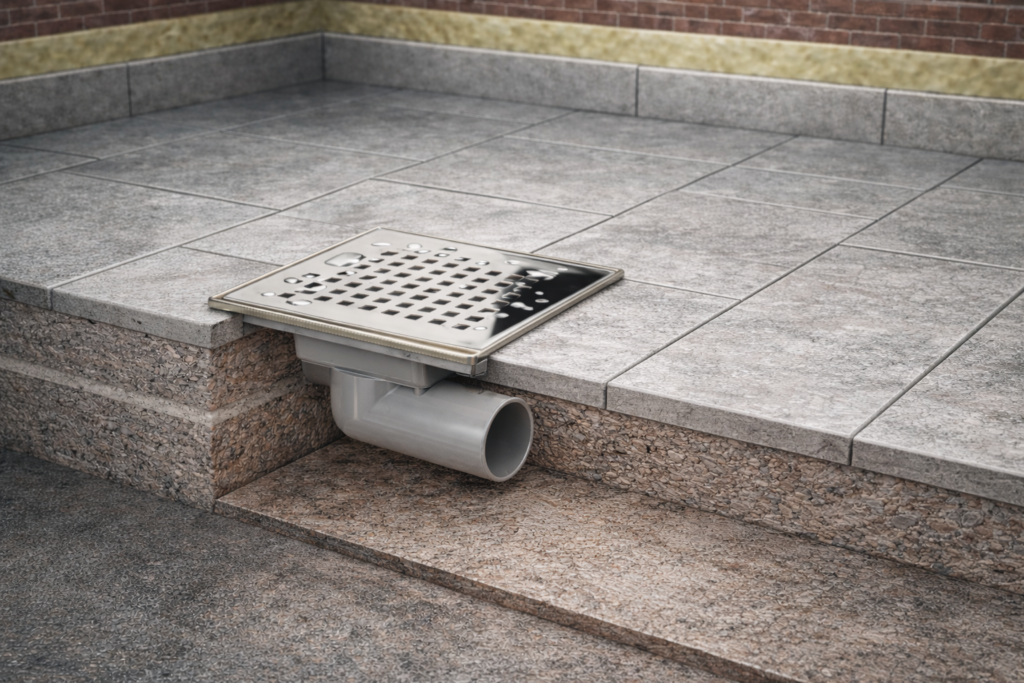
Underfloor heating is one of the most commonly chosen heating systems in modern construction. It provides comfort, aesthetics, and energy efficiency. However, its use also changes the requirements for other installation components – including floor drains. One of the most frequently overlooked issues is effective protection against odors from the sewage system, which becomes particularly important when underfloor heating is used.
Why traditional floor drains may not be sufficient?
Standard floor drains rely on a water seal (trap) that prevents odors from the sewage system from entering the room. This solution is effective, but only as long as water remains in the trap.
With underfloor heating, a significant issue arises:
- elevated temperatures accelerate water evaporation,
- in rarely used rooms, the trap may dry out,
- without water, the odor barrier is lost.
As a result, even a properly installed system can begin to generate unpleasant smells over time.
Underfloor heating and the risk of odors
The impact of underfloor heating on floor drain performance is often underestimated. Continuous exposure to heat speeds up processes that would normally take weeks under standard conditions.
The most common consequences include:
- faster drying of the trap,
- increased susceptibility to odor backflow from the system,
- reduced comfort of the room.
This is why traditional solutions may no longer be sufficient in such conditions.
Double trap sealing – a new standard
The answer to this issue is the use of floor drains with double trap sealing, combining two protective mechanisms:
Water seal
A classic barrier based on water retained in the trap.
Mechanical seal (dry trap)
A component that automatically blocks airflow when water is absent.
This ensures that:
- protection remains effective even after water evaporation,
- the system is secured regardless of usage frequency,
- the risk of odors is virtually eliminated.
In the context of underfloor heating, this solution should be treated as a standard rather than an optional upgrade.
Why does it matter for the entire building?
A floor drain does not function in isolation—it is part of a larger sewage system. Without effective odor protection, smells can spread:
- between rooms,
- between floors,
- and in multi-family buildings—even between apartments.
Using double trap sealing:
- improves the tightness of the entire system,
- enhances comfort for all occupants,
- raises the overall technical standard of the building.
When is it especially important to choose the right drain?
A floor drain with double odor protection is particularly important when:
- underfloor heating is installed,
- the drain is used occasionally (e.g., laundry rooms, guest bathrooms),
- a high standard of finishing is required,
- the project involves multi-family or commercial buildings.
In these cases, the right choice directly affects long-term usability and comfort.
Summary
Underfloor heating changes the operating conditions of sanitary installations, including floor drains. Accelerated water evaporation from the trap means that traditional solutions may not provide sufficient protection against odors.
For this reason, floor drains with double trap sealing should now be considered a standard in such installations. It is a small component that significantly impacts comfort, hygiene, and the durability of the entire system.
Making the right choice at the design stage helps avoid issues that typically appear only during use—when fixing them becomes far more difficult and costly.
Our product indexes:
11301, 11302, 11303, 11304, 11307, 11312, 11313, 11315, 11316, 11317, 11318, 11322, 11345, 11348, 11402, 11403, 11415, 11418