
 Mon – Fri 7:00 AM – 4:00 PM
 + 48 (52) 386 03 48


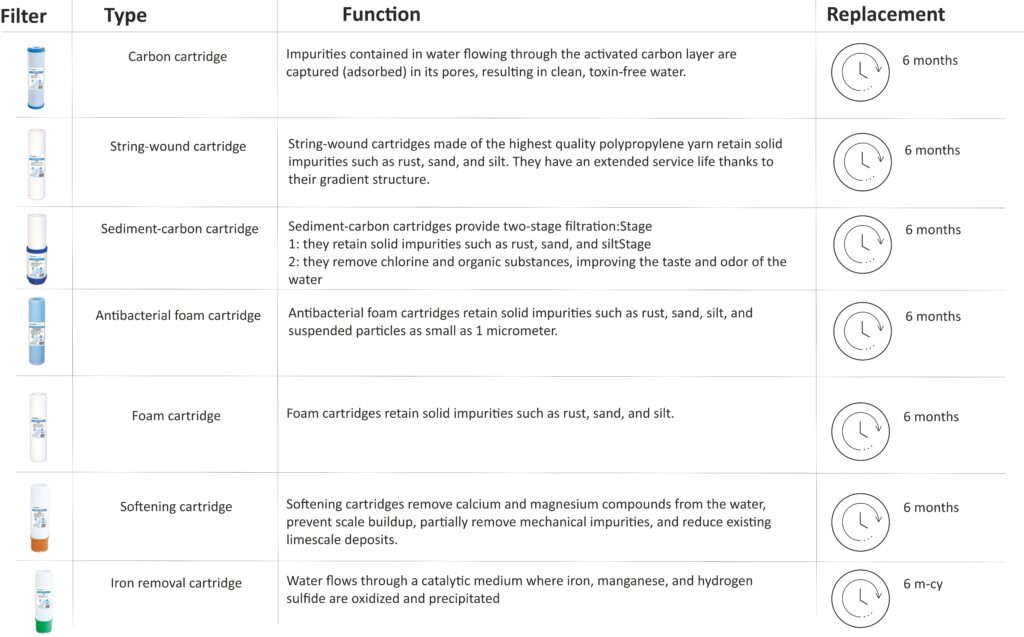
The quality of water in domestic and industrial installations has a direct impact not only on the health of users, but also on the durability of equipment and the comfort of everyday use.
Water treatment systems are based on various types of filter cartridges, each serving a specific function. The selection of an appropriate solution depends on the type of contaminants and the desired final effect.
Carbon cartridge – chlorine removal and taste improvement
Carbon cartridges are among the most popular components of filtration systems. They utilize the properties of activated carbon, which, thanks to its porous structure, effectively adsorbs chemical contaminants.
Their main functions are:
- removal of chlorine and its derivatives,
- elimination of organic compounds,
- improvement of water taste and odor.
These cartridges are particularly recommended for municipal water systems, where chlorine is commonly present. They are often used as one of the final stages of filtration.
String-wound cartridge – protection against mechanical impurities
String-wound cartridges are made of high-quality polypropylene yarn and are designed to retain solid contaminants.
They effectively remove:
- rust,
- sand,
- silt,
- other suspended particles.
Thanks to their gradient structure, they have an extended service life. They are often used as the first stage of filtration, protecting subsequent cartridges and water system components.
Sediment-carbon cartridge – two-stage filtration
This type of cartridge combines mechanical and chemical filtration functions, providing comprehensive water purification in a single element.
The process occurs in two stages:
- Mechanical filtration – removal of solid particles (rust, sand, silt)
- Carbon filtration – removal of chlorine and organic substances
The result is water that is not only cleaner but also better in taste and odor. This solution is ideal where system simplification is desired.
Antibacterial foam cartridge – high filtration precision
Antibacterial foam cartridges provide very fine mechanical filtration, retaining contaminants as small as 1 micrometer.
They remove:
- fine suspended particles,
- rust,
- sand,
- silt.
Additionally, they have antibacterial properties, which increases water safety. They are used in systems requiring a high level of filtration purity.
Foam cartridge – basic mechanical filtration
Standard foam cartridges perform a similar function to string-wound cartridges but have a more uniform structure.
Their applications include:
- removal of mechanical impurities,
- system protection,
- preliminary water filtration.
They are an economical and effective solution in many water treatment systems.
Softening cartridge – protection against scale
Hard water is one of the most common issues in water systems. Softening cartridges reduce calcium and magnesium ions responsible for limescale formation.
Their functions include:
- water softening,
- prevention of scale buildup,
- partial removal of mechanical impurities,
- reduction of existing deposits.
Using such cartridges significantly extends the lifespan of appliances such as kettles, coffee machines, and heating systems.
How often should filter cartridges be replaced?
Most filter cartridges should be replaced approximately every 6 months. However, this frequency may vary depending on:
- the quality of incoming water,
- usage intensity,
- the type of cartridge used.
Regular replacement is essential to maintain filtration efficiency and user safety.
Summary
The selection of appropriate filter cartridges should be carefully considered and tailored to the actual needs of the installation. In practice, multi-stage systems are most commonly used, combining different types of filters to ensure comprehensive water treatment.
The combination of mechanical filtration, chemical filtration, and softening allows for water that is:
- clean,
- safe,
- free from unpleasant taste and odor,
- friendly to devices and installations.